
Where to Buy Microwave Containers Wholesale in Riyadh, Jeddah and Dammam
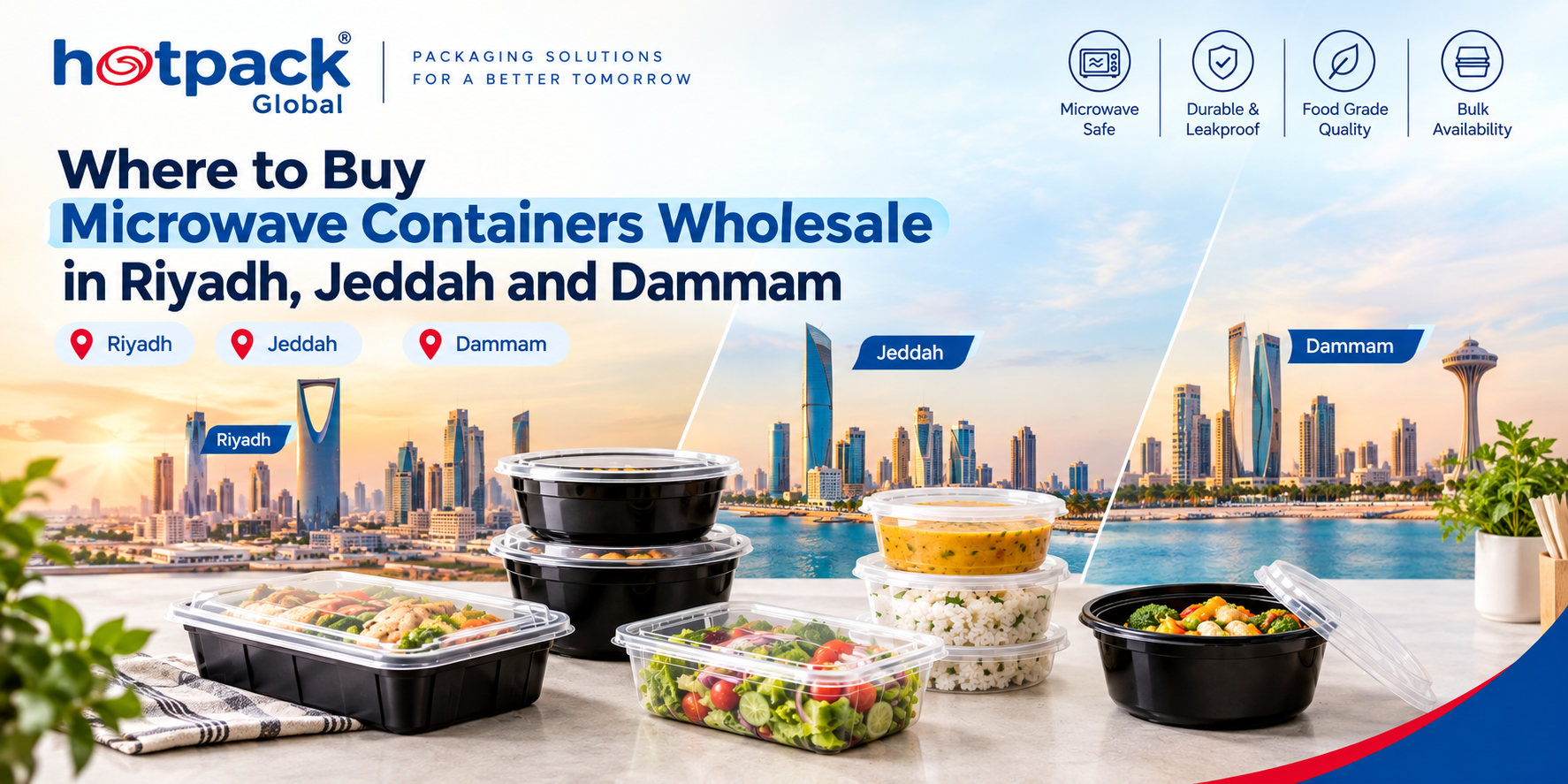
Quick answer: Buy direct from a manufacturer. It is the cheapest route at volume and the only one where a single company answers for quality, specification and supply. Hotpack Global sells microwave containers wholesale to restaurants, cloud kitchens, caterers and retailers in Riyadh, Jeddah and Dammam.
Why this question keeps coming up
Picture a cloud kitchen in Riyadh on a Thursday evening. Orders stack up across three delivery apps, kabsa goes into containers by the dozen, and every one of them has to survive a motorbike ride and a microwave at the other end. If a lid pops, the customer remembers the brand, not the container.
That is the quiet shift in Saudi food service. Delivery-first concepts, meal-prep subscriptions and a busy catering trade have turned reheatable packaging into a line item owners watch closely. Not long ago the question was who sells cheapest. The better one now is who will still be sending the same container in month nine.
Three ways to buy, and who each one suits
Manufacturers come first for most businesses. There is no middle margin, and if a batch goes wrong you know exactly whom to call. Hotpack Global holds ISO 9001, 22000, 14001 and 45001 certifications, plus BRC GS, SEDEX and ESMA, and ships to more than 96 countries. Certificates do not guarantee a good container, but they say something about how consistently a factory runs.
Distributors and wholesale traders work for smaller operators who want a bit of everything in one delivery. Range is the appeal. Consistency between orders can be the catch, and traceability sometimes gets thin.
Retail and online marketplaces are fine for a trial run or an emergency restock. Pack sizes are built for households, and the pricing shows it.
Owners who order every month tend to end up on a supply agreement with a manufacturer. It is less exciting than shopping around, and it saves a great deal of hassle.
What to check before you commit
The material. Two containers can look identical and behave nothing alike once the microwave is running. Ask for the specification and look for the microwave-safe marking. If you sell chilled or frozen meal-prep, confirm freezer suitability separately, because the two ratings do not always travel together.
The format. A grilled platter needs different packaging from a portioned meal box. Compartment trays keep rice, protein and sides from bleeding into each other, which is the whole point of a good meal-prep offer. Hotpack's 2- and 3-compartment black-base containers ship in cartons of 50, at roughly 221 by 151 mm for two compartments and 229 by 179 mm for three. For single portions, the black round microwavable container is listed as microwave and freezer-safe and made with takeout and delivery in mind.
The lid. Lids deserve more attention than they get. Fill a sample with your oiliest dish, snap it shut, and carry it around for an hour. It is a crude test, and it catches most problems before your customers do.
The paperwork. A supplier serving food businesses should be able to show food-contact compliance documents that apply to the Saudi market without being chased for them.
The branding. If a printed lid or private-label packaging matters to you, raise it at the start. Custom work can change minimum quantities, and it is better to hear that before you have fallen for a design.
Riyadh is the volume market. Restaurants and cloud kitchens sit packed close together, demand runs steady, and bulk orders are simply how business gets done. A supplier here needs to be dependable on the tenth order as much as the first.
Jeddah behaves differently. Umrah and Hajj seasons push catering volumes up fast, and a supplier who cannot scale on short notice becomes a problem at exactly the wrong moment. If your business touches pilgrim catering, plan stock well ahead of the season, not during it.
In Dammam and the wider Eastern Province, hospitality mixes with industrial catering, so regular scheduled deliveries count for more than flexibility. Predictability is the currency there.
Whichever city you operate in, ask for the lead time to that specific city, and ask how it stretches in peak weeks. Set your stock buffer from the answer, not from optimism.
Every business has different needs, and choosing the right product makes all the difference. With stores across Riyadh, Jeddah, and Dammam, you can explore Hotpack’s products in person, compare sizes, materials, and quality, and choose the best fit for your business requirements.
Questions worth asking every supplier
Ask about minimum order quantity, and whether it changes with sizes or branding. Ask about lead time on repeat orders, which is often shorter than on the first. Ask whether samples are free, how the price moves as volume grows, and what happens when a batch arrives defective.
That last one tells you the most. A supplier who fumbles these questions during the quote is unlikely to get better after the purchase order is signed.
One supplier for the rest of the packaging
Containers rarely travel alone. Hot catering trays often go in aluminium containers, cold items in clear plastic, and everything leaves the kitchen in a bag or box. Buying across the plastic products range and aluminium from one manufacturer keeps ordering simple and specifications consistent from dish to dish. Hotpack Global lists more than 4000 products across paper, plastic, aluminium, hygiene and other categories, so most of a kitchen's disposable needs can sit under a single account.
If you want to compare sizes and lids before committing to volume, the Hotpack Webstore microwavable containers collection is a low-risk place to start. From there, request a quotation with your monthly volume, sizes and branding needs, and ask for samples. A sample costs little. A wrong bulk order does not.
Three mistakes buyers make
The first is ordering on price per piece alone. A cheaper container that leaks or warps costs more in refunds and reputation than the few halalas saved. The second is skipping samples because the deadline is tight. Samples take days, and a bad bulk order takes months to clear. The third is buying one size for everything. Kitchens that standardise on a single container end up overfilling some meals and swimming others in empty space, so a small, well-chosen range of sizes usually works out cheaper overall.
Frequently asked questions
Can microwave containers go in the freezer? Many can, but it depends on the material. Check the product specification before using one for frozen meals.
Are black microwave containers fine for hot food? Yes, if they are sold as microwave-safe. Look at the temperature guidance for the exact product.
Can aluminium containers go in the microwave? No. Use microwave-safe plastic for reheating, and keep aluminium for the oven, catering and takeaway.
Do I have to order custom-printed containers? No. Standard stock is available, and printing is optional.
Where can I compare sizes before ordering wholesale? Start with the microwave containers category, then ask for a quotation on the sizes you need.
Recent Blogs